From Observation to Action: A CISO’s Pragmatic Lens on Identity Blast Radius

Why preemptive identity exposure management is replacing legacy posture tools — framed through industry frameworks.
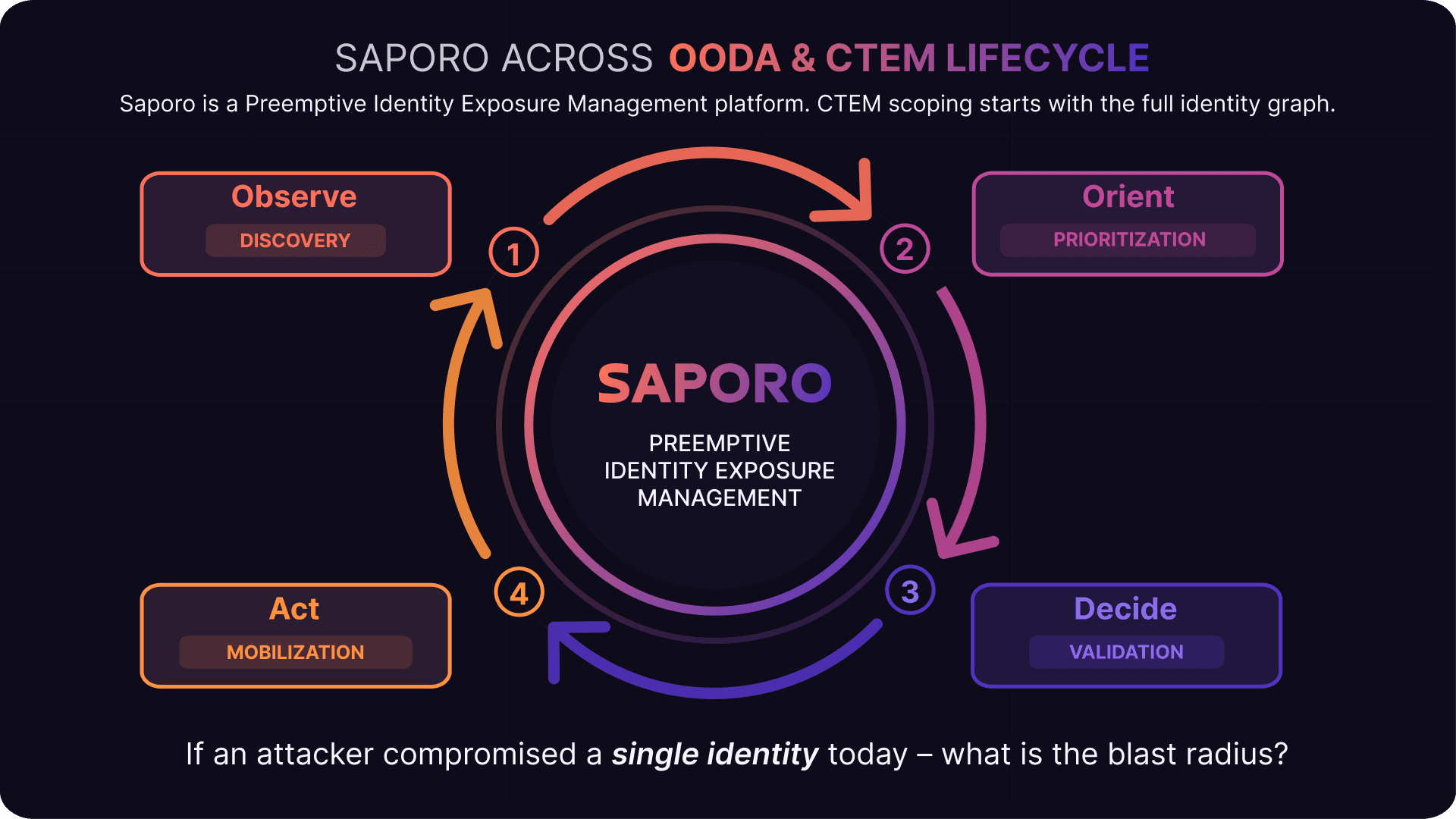
The OODA Loop — Observe, Orient, Decide, Act — is the decision cycle adopted by the world’s fastest-moving organizations to build durable competitive advantage. Continuous Threat Exposure Management (CTEM), Gartner’s five-stage cycle of Scoping, Discovery, Prioritization, Validation, and Mobilization, applies the same idea to security: turn exposure data into a continuous loop that compounds defensive value with every iteration.
If an attacker compromised a single identity in your environment today, how far could they go?
That is the question most identity security programs still struggle to answer. Dashboards are full of findings, posture scores, and policy checks — yet leaders still lack a clear picture of how risk compounds across trust relationships, delegation chains, and privilege inheritance paths. This is the blast-radius question, and it is the one Saporo was built to answer.
Most organizations still take a reactive approach to identity security. It is not for lack of expertise — modern environments are rarely well-segmented at the identity-and-access layer, and critical risks often remain hidden inside legitimate access. Attackers will get in. The challenge is making sure they cannot easily reach what matters most.
The discomfort, for most organizations, is not that their tools are broken. It is that the entire category was built on a legacy foundation of lists and findings rather than the graph reality attackers exploit.
"Defenders think in lists. Attackers think in graphs. As long as this is true, attackers win." — John Lambert, CTO of the CISO organization, Security Fellow, Corporate Vice President, Microsoft
The organizations that win against identity-based threats will not be those with the longest list of detected misconfigurations and attack paths. They will be the ones with adaptability — the ones that can observe their full identity landscape, orient around the exposures that actually matter, decide on the right remediation with confidence, and act before attackers exploit the gap.
Has the Category Caught Up to the Problem?
For years, identity exposure could be tackled through Attack Path Management (APM) as a technique, packaged inside Identity Security Posture Management (ISPM) as a sub-category. Gartner has now defined a broader, outcome-oriented emerging category — Preemptive Identity Exposure Management (PIEM) — that places ISPM and APM inside a single frame: eliminate exploitable identity exposures before adversaries discover them.
Saporo is positioned squarely in PIEM, with full ISPM coverage and a graph-native APM engine at its core.
We built Saporo to give defenders the strategic advantage attackers already use: graph-based visibility. By analyzing identity relationships, misconfigurations, and identity event logs, Saporo uncovers hidden attack paths and exposures that traditional tools miss. With that visibility, defenders can anticipate lateral movement and privilege escalation, break attack paths, and make access to critical assets significantly harder — before it is too late.
The rest of this article uses OODA and CTEM as the operating lens to show what a complete PIEM program looks like in practice.
A Decision Framework for Identity Security
Attackers chain trust relationships and privilege escalations faster than static lists can track. Defenders need a decision cycle that moves from visibility to validated action in a continuous loop.
Gartner’s Continuous Threat Exposure Management (CTEM) framework defines a lifecycle of Scoping, Discovery, Prioritization, Validation, and Mobilization. The OODA Loop maps naturally onto these stages, sharpening each with a decision-speed lens on identity security tied to the realities of your business:
Framework Parallel: OODA ↔ Gartner’s CTEM
CTEM “Scoping” is implicit — for Preemptive Identity Exposure Management (PIEM), the scope is the full identity graph.
OODA Phase | CTEM Stage | What Saporo Delivers |
|---|---|---|
OBSERVE | DISCOVERY | Agentless discovery maps the full identity access and attack-path graph — every trust chain, delegation, misconfiguration, privilege path, compliance check, and identity event logs across human and non-human identities. |
ORIENT | PRIORITIZATION | Rank identity exposures by real impact, blast radius, and role in attack paths — surfacing misconfigurations, dangerous changes, and attack paths with chokepoints — where one fix eliminates the largest blast radius. |
DECIDE | VALIDATION | Predictive validation through real-world feasibility — Saporo computes millions of viable attack paths to surface only what is exploitable today, so teams know what is worth fixing now and what is noise. |
ACT | MOBILIZATION | Turn validated priorities into remediation workflows across the identity security fabric and platform teams — with measurable change feedback that fuels the next iteration. Coming in Saporo v5 (mid-2026): remediation workflows that turn validated exposures into safe, reviewable change actions — preserving change ownership with platform teams. |
Observe (Discovery): The Identity Exposure Problem Is a Graph Problem
Observation means building the most complete picture of reality possible. In identity security, that means mapping the full access and attack graph — the trust chains, delegation paths, group nestings, and privilege inheritance that list-based scanners miss. The sheer scale of modern identity, across both human and non-human identities, makes this a needle-in-a-haystack problem: thousands of accounts, groups, roles, and service principals generate millions of relationship edges. Analyzing that full graph manually is not feasible — and attackers only need to find one overlooked path.
A seemingly minor service account three hops away from a Domain Admin or Enterprise Admin can represent more meaningful risk than a standalone misconfiguration with a higher severity label — but only if you can see the path between them. In most phishing-driven incidents, attackers reach critical assets and business-impacting operations without ever needing a misconfiguration or a privileged role.
That is why the ability to observe through a blast-radius lens has moved from nice-to-have to non-negotiable for CISOs. Many tools focus only on the attack graph — adopting the attacker mindset to chase critical assets. Defenders need both the access graph (legitimate, designed-in relationships) and the attack graph (exploit-driven paths). Without both, every subsequent phase — orient, decide, act — is built on incomplete inputs.
THE OBSERVATION GAP
Lists show fragments. Graphs show relationships — which is exactly what attackers see. Closing this observation gap is the first step toward a faster, more effective decision cycle.
The Market Is Splitting in Two
As ISPM matures as a sub-category and APM matures as a technique, a clear architectural divide is emerging within the broader Preemptive Identity Exposure Management (PIEM) category — between two fundamentally different approaches: list-led and graph-native.
Platform-Led Vendors: Strong on Observe, Weak on Orient
Large EDR/XDR providers have bolted identity modules onto their security suites. These tools deliver breadth — hybrid visibility, compliance dashboards, tight SOC integration — and are reasonably good at the Observe phase. But their identity capabilities remain configuration-centric rather than path-centric, surfacing scored lists rather than modeling how misconfigurations chain into exploitable attack paths. Breadth across many domains comes at the cost of depth in any single one — and identity security demands the opposite trade-off: deep graph fidelity in the layer where lateral movement and privilege escalation actually happen. Some also introduce deployment dependencies that slow the cycle.
Attack Path Specialists: Strong on Orient, Weak on Decide and Act
On the other side, specialist vendors have built high-fidelity attack-graph engines that model identity relationships across Active Directory, Entra ID, AWS, Google Cloud, Okta, and adjacent ecosystems. These tools excel at orientation — showing security practitioners exactly how an attacker could traverse trust relationships to reach critical assets.
Historically, however, many have under-invested in the operational workflows enterprise buyers need for the Decide and Act phases — exploitability validation, compliance mapping, executive reporting, and broad hybrid-cloud identity coverage. Without those capabilities, mitigation stalls. Teams can see the problem but cannot move confidently to resolution.
There is also a graph-depth gap. Today’s attackers increasingly do not need to exploit a misconfiguration or vulnerability at all — they traverse legitimate access-graph trust relationships and delegation paths that were configured exactly as designed. Defenders therefore need to go beyond finding what is “broken” and properly segment the environment by reducing Relationship-Based Access (ReBAC) — the implicit, transitive access that accumulates across group nestings, role assignments, and trust chains. Without ReBAC reduction, even a perfectly patched environment can leave wide-open lateral-movement corridors. Saporo equips identity security practitioners with deep access- and attack-graph fidelity, on top of compliance checks and identity event-log monitoring.
The defensive principle is well established. Microsoft’s tiered administration model separates administrative access and critical systems into isolated trust levels — designed to contain the blast radius of any single compromise and prevent an attacker who lands on a lower-tier account or workstation from moving laterally into highly privileged environments such as domain controllers, identity providers, and other Tier 0 assets. Saporo operationalizes that principle continuously across the full hybrid identity graph — not as a one-time architecture review, but as a live measure of how well tiering is actually holding under real, traversable conditions.
THE MARKET TRUTH
Neither approach alone completes the end-to-end cycle. Lists without graph context cannot rank by real impact, blast radius, or role in attack paths at the Orient phase. Graph analysis without operational follow-through stalls at Decide and Act. The winner will be the platform that accelerates the entire loop.
Orient (Prioritization): Ranking by Real Impact, Blast Radius, and Attack-Path Role
Orientation is where graph-native architecture proves decisive. Attack-path modeling is more than visibility — aligned with PIEM, it ranks every identity exposure by real impact, blast radius, and role in attack paths, so teams see how an attacker could reach a critical asset before the exploitation actually occurs.
When most tools blindside your practitioners by omitting the access graph or modeling only shallow attack paths, qualitative depth beats quantitative volume every time.
Saporo’s platform starts with a graph-native engine that models the full complexity of hybrid identity environments — Active Directory, Entra ID (Azure AD), ADCS certificate services, and cloud identity providers. Attackers do not respect the boundary between your legacy Active Directory and your modern Entra ID or AWS environments. Effective orientation requires mapping the entire hybrid bridge.
Rather than generating a ranked list of misconfigurations, Saporo maps every identity relationship, trust chain, compliance signal, identity event log, and privilege-escalation path to identify the specific chokepoints — the convergence points where a single remediation action eliminates the largest number of attack paths simultaneously. We call this chokepoint engineering: the discipline of turning millions of possible attack paths into a short, actionable remediation list.
When a handful of architectural chokepoints can collapse 80% of the exploitable attack surface, the economics shift. For security teams operating with limited resources and competing priorities, that analytical focus is the difference between a stalled mitigation program and one that compounds with each iteration.
List-based ISPM mops puddles one by one. Graph-native ISPM traces the pipes back to the master valves. Saporo's PIEM powered by graph-native ISPM not only prioritizes which master valves to fix first — it shows how, and what fixing them will achieve, before you turn the wrench.
Decide (Validation): Focus on What’s Actually Exploitable
The Decide phase is where most programs stall. Modifying Active Directory or Entra ID carries real operational risk. Teams know what to fix; they hesitate because they cannot assess the downstream impact of the fix.
Saporo delivers predictive validation by continuously computing millions of viable attack paths to determine how attackers could realistically reach critical assets in the live environment. Unlike traditional breach simulation — which must replay attacks one by one — Saporo validates exposure continuously, at full identity-graph scale, without disrupting production.
Two platform features bring this validation into a CISO’s daily workflow: Impact Indicator and Business Impact. Together, they accelerate decisions from “I think this is important” to “I know these are the critical priorities for the business.”
Each finding is filtered by current exploitability — only identity attack paths actually traversable today make the cut, with their reachability, blast radius, and impact on critical assets made explicit. Teams prioritize changes that demonstrably move their Attack Path Resistance Score — a roll-up measure of how much structural resistance the environment has against identity-based attack paths — align stakeholders on what to fix first, and commit to action with confidence. This closes the gap between “identified” and “resolved” that plagues most identity security programs, and turns the OODA Loop from a conceptual framework into operational reality.
PREDICTIVE VALIDATION = DECISION VELOCITY
Without exploitability focus, Decide drowns in noise. Change-management boards deliberate for weeks against equally-urgent-looking findings. With validated identity attack paths — only the ones actually exploitable today — teams cut review cycles from weeks to days and route effort to the changes that demonstrably reduce blast radius.
Act (Mobilization): Deployment Independence and Continuous Iteration
The Act phase is where deployment friction can slow the entire cycle. The last thing a CISO needs is another tool that requires a specific endpoint agent, creates vendor lock-in, or forces concessions on data sovereignty.
Saporo takes a fundamentally different approach. Our platform is fully agentless, fully deployable on-prem, collecting identity data through native directory protocols without requiring any endpoint software. Customers typically deploy within 1 to 3 hours rather than weeks — with no dependency on a specific endpoint platform and the flexibility to operate independently of broader security-stack decisions.
The Act phase is not a finish line — it is the start of the next loop. Saporo’s continuous monitoring and posture scoring measure the impact of each remediation, update the graph in real time, and feed results back into the next iteration of CTEM and OODA.
That feedback loop sets the stage for the next leap in Mobilization. In Saporo v5 (mid-2026), remediation workflows will close the distance between a validated exposure and the executed change — drafting reviewable remediation actions, surfacing rollback paths, and keeping accountable humans in the loop at every step with an option to use generative AI to build and guide the workflows.
WHAT’S NEXT IN SAPORO v5 | MID-2026
The biggest leap in the Act phase yet: remediation workflows purpose-built for the Mobilization stage of CTEM. Validated findings become safe, reviewable change actions — accelerating time-to-remediation while preserving change ownership with platform teams and a clear audit trail for risk owners.
Measuring What Matters: From Compliance Checklists to Posture Velocity
Executive stakeholders want risk posture in terms they can act on: Are we reducing identity exposure? How fast? Where are the gaps?
That is where reporting becomes part of the loop rather than an afterthought. Compliance dashboards and board-ready summaries are the feedback layer that tells leadership whether security investments are actually moving the needle.
Saporo maps identity security findings against 700+ regulatory and framework controls — including ISO 27001, CIS, SOC 2, ANSSI, and MITRE ATT&CK — translating technical posture into business-risk language so the same intelligence that guides remediation also informs the decisions that happen at the leadership level.
The OODA- and CTEM-Aligned Buyer’s Checklist for PIEM
As the emerging PIEM category continues to evolve, we encourage security leaders evaluating identity security solutions to pressure-test each vendor against the full OODA cycle:
CTEM “Scoping” is implicit — the full identity graph.
OODA / CTEM Stage | Question to Ask | What a Strong Answer Looks Like |
|---|---|---|
OBSERVE / DISCOVER | Does the platform model access and attack paths as a graph, or primarily as a scored list of findings? | Surfaces the full exposure landscape through in-depth graphs — connecting misconfigurations, event logs, and compliance signals across the environment, rather than as isolated findings. |
ORIENT / PRIORITIZE | Can it prioritize exposures by blast radius and impact across hybrid identity environments — AD, Entra ID, ADCS, and cloud providers? | Prioritizes exposure reduction by blast-radius, not finding count. Partial coverage creates blind spots that attackers exploit. |
DECIDE / VALIDATE | Does the platform validate which exposures are actually exploitable today, reducing noise across findings? | Filters posture noise down to validated identity attack paths — those actually exploitable today — so teams act on changes that move blast radius rather than re-litigating low-impact findings. |
ACT / MOBILIZE | Is the solution agentless, EDR-independent, and able to support remediation workflows? | Deploys exposure reduction through reviewable change workflows that keep humans in the loop. Generates evidence-backed compliance reports for auditors and risk owners. No vendor lock-in. Saporo v5 (mid-2026) extends this remediation workflows across Act/Mobilization. |
Loop / Lifecycle | Can results be translated into compliance-mapped, board-ready reporting? | Creates a feedback mechanism that accelerates each subsequent iteration of the cycle and tells leadership, in business terms, whether the program is improving. |
The Path Forward: Winning the PIEM Race
Attackers think in graphs and move fast. Defenders need platforms that complete the full OODA Loop — observe, orient, decide, act — inside an accelerating CTEM cycle. That is the strategic vision of PIEM: eliminate exploitable paths before adversaries discover them, rather than reacting after the fact.
Saporo was built for defenders who recognize that identity security is a decision-speed challenge — and that the organization with the faster cycle wins.
The next chapter — remediation workflows in Saporo v5 (mid-2026) — pushes that decision velocity directly into the Act phase, where most programs still lose the most time.
Detection tells you the thief is in the building. Saporo preemptively ensures there are no hallways for them to walk through.
If you are evaluating how to reduce identity exposure across Active Directory, Microsoft Entra ID, Microsoft ADCS, and cloud identity, ask whether your current approach helps you complete the full loop from discovery to action.
Request a free Identity Exposure Assessment and get a clear picture of your blast radius across your full environment — and what to do about it.